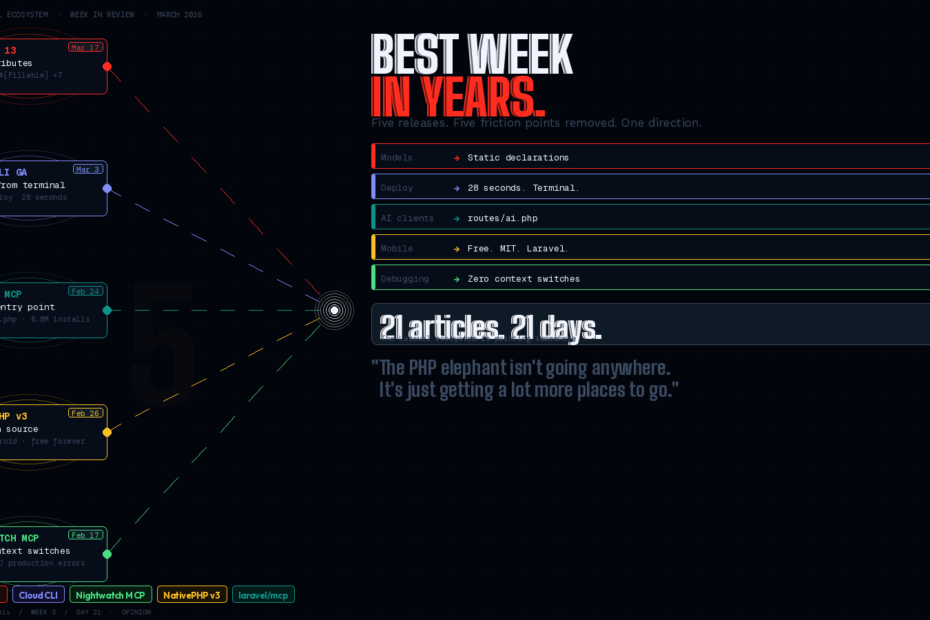
Five releases. Five different problems. One unmistakable direction.
I’ve been writing about Laravel every day for three weeks. This week was different.
Not because any single release was unprecedented. Taylor has shipped remarkable things before — Livewire wire:navigate changing how SPAs feel, Horizon making queue visibility genuinely good, Pulse arriving as a free alternative to paid APM tools. Individual releases being excellent isn’t new.
What was different this week was the pattern. Five releases landed in roughly seven days, and when you line them up, they’re not five separate improvements to five separate things. They’re five answers to the same question.
The question: what does a Laravel application look like in a world where AI is the primary interface?
The Five Releases
For anyone catching up:
Laravel 13 (March 17) — the major release, bringing PHP Attributes to Eloquent models (#[Table], #[Fillable], #[Connection] and six others), native attribute support across jobs, commands, and form requests, and deeper static analysis friendliness throughout.
Laravel Cloud CLI GA (March 3) — the Cloud API and CLI went generally available. cloud deploy runs in 28 seconds. cloud database:open tunnels to production. cloud command:run fires remote Artisan commands. Your full deployment workflow is now three terminal commands, and every step is scriptable for CI/CD.
Nightwatch MCP (February 17) — an MCP server for Laravel Nightwatch, Anthropic’s error monitoring product. Claude Code connects to your production exception tracker. An AI agent can now investigate, triage, and close the loop on production errors without you switching context once.
NativePHP v3 (February 2026) — MIT licensed, free forever, plugin architecture. Nine free native plugins. iOS and Android apps built with the Laravel stack you already know. The license fee is gone. The barrier is gone.
laravel/mcp (v0.6.0, February 24) — an official MCP server framework in the Laravel 12 docs. 8.8 million installs. Your Laravel application gets a fourth entry point — one that AI clients can discover and call directly. Tools, Resources, Prompts. routes/ai.php.
Five releases. Let’s talk about what they actually mean together.
The Thread Running Through All Five
Every one of these releases is, at some level, about removing a friction point between your Laravel application and the world it operates in.
Laravel 13 attributes remove friction between your intentions and your code. The protected $table = 'users' property works. It has always worked. But it forces you to communicate configuration as mutable runtime state rather than as static declaration. PHP attributes are metadata. They’re closer to what you actually mean — “this class maps to this table” — than a property that could theoretically be changed at runtime. Smaller friction. Clearer code. Better static analysis.
Cloud CLI removes friction between your code and production. The old story: write code, commit, push, wait for CI, navigate to Forge or Vapor, watch a deploy, SSH in to check logs. The new story: cloud deploy, cloud logs, cloud database:open. The terminal is the interface. The feedback loop is 28 seconds. The operational gap between development and production shrinks to almost nothing.
Nightwatch MCP removes friction between production problems and understanding them. Before: exception fires, you get a Slack ping, you open a browser, find the error, copy the stack trace, paste it into Claude, get an analysis, go back to Nightwatch for more context, iterate. After: Claude Code connects to Nightwatch, you describe the problem, it investigates, you stay in your editor. The context-switching that made debugging feel expensive? Gone.
NativePHP v3 removes friction between the web and native. The old story: your Laravel SaaS has a web app, and if your users want a mobile app they either accept a PWA that feels off or you find budget for a React Native team. The new story: composer require nativephp/mobile, php artisan native:run ios. Same language, same patterns, same team.
laravel/mcp removes friction between your application and AI clients. The old story: you build an API, write documentation, hope the AI reads it correctly, watch it hallucinate endpoint names. The new story: Mcp::web('/mcp', YourServer::class). The AI connects to your MCP server, discovers exactly what your application can do, and calls it with validated inputs. Your users interact with your app through Claude or ChatGPT without ever opening a browser tab.
Five friction points. Five removals.
The Shift That’s Actually Happening
There’s a word that keeps appearing in Laravel’s documentation that didn’t appear two years ago: agentic.
Laravel 12 docs introduced an “Agentic Development” section. The routes/ai.php file sits alongside routes/web.php and routes/api.php. Laravel Boost auto-configures your MCP server for Claude Code. The Cloud API exists specifically so AI agents can deploy your application conversationally.
Laravel is being built, consciously and deliberately, as a framework for the agentic era.
This isn’t hype. It’s architecture. When you add routes/ai.php to your application, you’re not bolting on an AI feature — you’re adding a new interface layer, the same way routes/api.php added a machine-readable interface layer in the 2010s. The API was the answer to “how do apps talk to other apps?” MCP is the answer to “how do apps talk to AI agents?”
The developers who built great JSON APIs in 2015 weren’t following trends. They were preparing their applications for a world that was coming. The developers building MCP servers in 2026 are doing the same thing.
What the Skeptic Says
I want to be honest about the counterarguments, because not everything lands perfectly.
NativePHP v3 is promising but still experimental. The “no Swift, no Kotlin” pitch is real, but for complex, performance-sensitive, or heavily animated apps, you’ll hit the limits of a PHP-in-a-WebView architecture. The right use case is field tools, internal apps, companion apps — not the next Spotify.
laravel/mcp at v0.6.0 is early. 8.8 million installs is real adoption, but the protocol is still evolving and tooling is immature. Connecting a public MCP server to Claude.ai and watching it actually work for your users is still a project, not a weekend afternoon.
Agentic development is mostly hype for most apps right now. The developers who will build genuinely valuable MCP integrations are a small fraction of the Laravel community today. Building routes/ai.php for a CRUD app because it’s new is a great way to over-engineer something simple.
The honest take: these releases point in the right direction at different stages of readiness. Cloud CLI is production-ready today. PHP Attributes are production-ready today. Nightwatch MCP is production-ready for teams already using Nightwatch. NativePHP v3 is right for specific apps. laravel/mcp is worth learning now, worth deploying selectively.
The Real Story
I’ve been a PHP developer for a long time. Long enough to remember when “serious developers” didn’t use PHP. Long enough to watch Laravel turn that conversation around so completely that the framework is now cited in the same breath as Rails and Django when people talk about productive web development.
This week felt like another inflection point. Not as dramatic as Laravel 4 was — nothing is. But the pattern is the same: the ecosystem is cohering around an idea, and the idea is that your Laravel application should be natively reachable by AI agents, natively deployable from the terminal, and natively runnable on mobile devices, all without abandoning the stack you know.
The PHP elephant isn’t going anywhere. It’s just getting a lot more places to go.
The Week, Distilled
If you read nothing else: five things shipped this week that matter.
Laravel 13 makes your models cleaner and your code more statically analysable. Cloud CLI makes deployment a terminal command. Nightwatch MCP keeps you in flow state when production breaks. NativePHP v3 makes mobile development free and accessible. laravel/mcp makes your application reachable by every AI client your users are already talking to.
Taken together, they describe an ecosystem that isn’t just keeping up with where software development is going. It’s trying to lead it.
That’s worth writing about. That’s worth building with.
Follow for daily deep-dives on Laravel, PHP, Vue.js, and AI integrations.